Lesbian Getaways


Your Host & Organizer
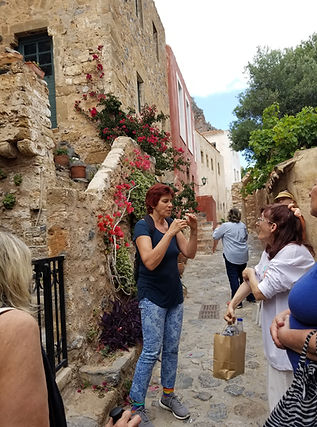
Jody Potiker
Join our adventurous lesbian community
In her words...
Because of my interest Greece’s spirit and ecology I studied Archaeology at Ioannina University, Greece and in Germany. I also hiked in the Greek mountains to explore the habitats of the wild flora.
Since then, I have achieved a post-doctoral research (post doc) at the British School of Archaeology in Athens. In 2006 I was honored with the prize of the Academy of Athens for my work that has been published in 2022.
Sharing ideas and working in groups always fascinated me. Conducting my PhD in Heritage Education (both environmental and cultural) I have learned how to develop programs that communicate ideas to students and adults through experiential work. I realize that learning occurs at a deeper level when people are fully immersed in the experience.
As I age, I realize more and more the importance of the excavation into one’s own self so I persued studies in Somatic Psychotherapy. I have been working as a Health Education Advisor (in mental, social, body health) in Secondary Schools for 27 years.
Today, combining the knowledge from the three fields (archaeology, ecology and somatic psychotherapy) I lead experience-based workshops at archaeological sites and in nature for the international community. I aim to facilitate healing of the soul, women's empowerment and to share ideas from Greek philosophy that are relevant and helpful today.
Writing has always been my life-long passion. Beyond publishing scientific papers in International Congresses, I have worked as a columnist in the National Herald (New York newspaper), written books, novels and scripts for documentaries and theatrical plays. In 2011, I was awarded a prize from "The Parthenon Marbles", an International Literary Competition. My piece was called "The story of a theft of History".
Luckily enough, I balance the writer’s sitting habits with my passion for dancing and kinesiology. Based on my background from different yoga trainings and dancing schools, I have developed the "Ensomatografia method",a Greek Alphabet Statues Yoga routine.
Realizing in my later years that ecstatic dance in ancient Greece meant to get out of stagnancy and habitual life routines, I try to find the courage to align with the fulfillment of not only my own desires but also those whom I have the opportunity to work with to align with theirs as well.
Dimitra Kamarinou
Biography
About Dimitra Kamarinou,Author: Dr Dimitra Kamarinou studied Archaeology at the University of Ioannina and did postgraduate studies in Archaeology and Art History at the Universities of Würzburg and Bochum, Germany. She holds a PhD from the University of Patras and has conducted post-doctoral research (post-doc) at the British School of Athens under David Blackman, Oxford University. He was a member of the “Interdisciplinary Group of Maritime Archaeology of Xylokastro”, investigating and presenting at International Conferences the maritime dimension of the Homeric epics and Mycenaean culture. For this work, which is the core of the book “NIES PONTOPOROI”, she was awarded the prize of the Academy of Athens in Archaeology in 2006. She has a remarkable body of writing and in 2011 she was awarded the prize of the International Literary Competition “The Parthenon Marbles. The story of a theft or the theft of history”. Her interests have extended on the one hand to modern Greek history with emphasis on that of women and on the other hand to experiential initiation into ancient Greek culture and the roots of ancient therapeutics. She is the author of the books “NIES PONTOPOROI. Homeric ships, daring voyages and maritime archaeology’. “Sailing and Civilizations of the Odyssey”, “Odysseus’ Raft”, “Naked Truths of Women. The unseen history”, “History frames. Games of the Greeks 1821-1923”, “The Project Method in Practice”, “Experiential Learning at School”, “Teaching History”, “Mountainous Corinthia” and the theatrical plays “You have a stand” – “What did you fight for, General Makriyannis?” and ‘Pale Rose’. He has participated with scripted texts and narration in the anniversary documentaries “Matrix Earth” and “Water Horizon” for ET1.
About her book
“NIES PONTOPORI -Homeric ships, daring voyages and Maritime Archaeology” by Dimitra Kamarinou, Ph.D. University of Patras, archaeologist, awarded by the Academy of Athens.The publication is unique for the Greek literature and fills a large gap in our knowledge of ancient Greek shipbuilding and naval tradition from the Mycenaean Age and Homeric times. The originality of the work, also in relation to the international literature, lies in the fact that, starting from the shipbuilding reading of Odysseus’ “raft”, the references in the Homeric epics to ships and sea voyages are juxtaposed with archaeological sources: Ship sketches in Mycenaean and Geometric Age vases, iconographic parallels of ships of all the naval cultures of the SE Mediterranean, shipwrecked ships throughout the Mediterranean over a period of a thousand years (14th – 5th century. BC). Unresolved questions, such as the role of the high topsail and the capabilities of the ships’ sailing and navigational rigging, are answered through technical studies and experiments. Charts, drawings, photorealistic representations, photographs of underwater excavations and museum objects enrich the synthesis of the picture of ships and life on transoceanic voyages. A thorough shipbuilding reading and interpretation of the construction of Odysseus’s ‘raft’ reveals that it is not a raft construction, but rather a precise guide to the phases of building a sailing ship of the period, with a sophisticated technique for joining the hull planks. In order to introduce the reader to a relatively unfamiliar subject, the author reconstructs her subject on three levels. The first is that of the core of her scientific research, which was awarded by the Academy of Athens (2006) and is presented in an understandable and comprehensible way for the general public. The second level, the “Stations” of the research, narrates the quests of the “Interdisciplinary Group of Naval Archaeology of Xylokastro”, which had the good fortune to carry out the study on the construction of a Mycenaean eikosoros at a time when Naval Archaeology was laying its foundations. On the third level, in the “Reversals” at the end of each chapter, the author, reconstructing the tangible material of the underwater excavations, recounts the adventures of a Mycenaean woman on a risky naval expedition to the then famous states of the SE Mediterranean. The book, the fruit of more than a decade of research, opens, in essence, a door of interpretation of the long-lasting actions of Greek civilization, already from prehistoric times, through which its character emerges more vividly: it demonstrates that it is not only characterized by the touch of the sea, but that its important choices and expressions were shaped through its maritime dimension.